
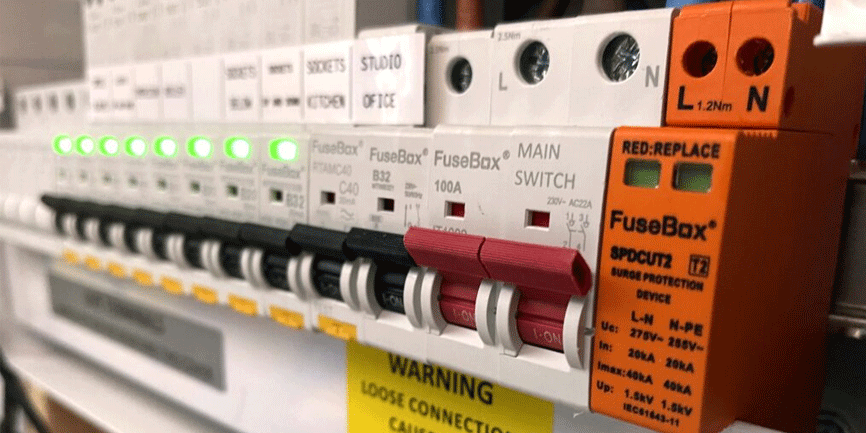
Description
A technical, clause-accurate guide to Arc Fault Detection Devices (AFDDs) for hotels, hostels, dormitories, and residential buildings. Includes IEC 62606, NBC 2016 Part 4, SP 30:2023 and IEC 60364-4-42 requirements.
Keywords
AFDD IEC 62606, arc fault protection, accommodation electrical safety, IEC 60364-4-42, NBC 2016 fire safety, SP 30:2023 electrical standards, arc fault detection devices India, series arc, parallel arc faults
Table of Contents
- Introduction
- Arc Fault Hazards in Accommodation Buildings
- IEC 62606: Device Requirements & Clause-Based Explanation
- Why AFDDs Are Critical in Sleeping Areas
- Global & Indian Regulatory Requirements
- AFDD Installation & Coordination Guidelines
- Device Selection Criteria
- Recommended Engineering Practices
- Conclusion
- FAQs
1. Introduction
Arc faults have emerged as one of the leading ignition sources in low-voltage installations, especially in buildings with sleeping accommodations—hotels, hostels, dormitories, service apartments, and high-rise residential towers. Traditional protection devices such as MCBs and RCCBs cannot detect series or low-energy parallel arcs.
The global standard IEC 62606:2013 + A1:2017 + A2:2022 (with COR1:2023) defines the performance requirements, testing, and behaviour of Arc Fault Detection Devices (AFDDs).
This guide provides a technical, clause-based explanation of AFDDs relevant to accommodation buildings, aligned with NBC 2016, SP 30:2023, and IEC 60364-4-42:2024.
2. Arc Fault Hazards in Accommodation Buildings
Sleeping areas pose unique electrical fire risks:
- Occupants are asleep and unable to detect burning smell, sparks, or early smoke.
- Faults commonly occur behind furniture, in concealed wiring, and ageing conductors.
- Loose terminations, broken conductors, and insulation deterioration generate series arcs.
- Parallel arcs may occur in old wiring and damaged cable insulation.
These hazards are often undetectable by MCBs or RCCBs because:
- MCBs sense overload/short-circuit
- RCCBs sense earth leakage
- Neither detects arc signatures
AFDDs recognise the high-frequency arc signatures and disconnect the supply before ignition occurs.
3. IEC 62606: Device Requirements (Clause-Based Summary)
3.1 Device Types — Clause 1 & 4.1
IEC 62606 recognises the following configurations:
- Standalone AFDDs.
- AFDDs integrated with MCBs
- AFDDs integrated with RCCBs
- Plug-in / add-on AFDD modules
Rated for AC low-voltage circuits up to 230 V and 63 A.
3.2 Performance Requirements — Clause 5.3.7
Trip time is inversely proportional to arc intensity.
- High-energy arc → very fast disconnection
- Low-energy arc → evaluated signature before tripping
The device must differentiate:
- Normal switching transients
- EMC noise
- Load variations
3.3 Environmental & Construction Requirements — Clauses 7 & 8
AFDDs must comply with:
- Temperature & humidity tests
- Mechanical endurance
- Insulation requirements
- Dielectric and EMC limits
3.4 Testing Requirements — Clause 9
IEC 62606 mandates:
- Type tests
- Routine manufacturing tests
- Arc generation simulation tests
Tested fault types:
- Series Arc Faults — broken/loose conductors
- Parallel Arc Faults — L–N faults
- Non-dangerous Arc Conditions — filtering
4. Why AFDDs Are Critical in Sleeping Areas
Accommodation environments involve:
- Reduced human response (occupants asleep cannot respond to early warning signs)
- High furniture density creating confined hotspots
- Concealed wiring that increases risk from hidden arcing
4.1 Reduced Human Response
Occupants asleep cannot respond to early warning signs.
4.2 High Furniture Density
Arc faults behind:
- Beds
- Wardrobes
- Wooden panels
- Headrests
- Curtain tracks
These create confined hotspots where ignition can occur unnoticed.
4.3 Concealed Wiring
Arcing from:
- Conduit joints
- Pressured conduits under furniture
- Humidity-affected wiring
- Loose terminals in sockets & switches
AFDDs dramatically reduce ignition probability by detecting arc signatures early.
5. Regulatory Requirements
5.1 IEC 60364-4-42:2024 (Clause 426.3)
AFDDs are recommended/required in:
- Sleeping rooms
- Buildings constructed primarily of combustible materials
- Locations with increased fire risk
- Heritage structures
- Agricultural buildings
This clause is the global basis for national adoption.
5.2 National Building Code of India (NBC 2016, Part 4)
NBC highlights electrical fire safety in:
- Hotels
- Residential towers
- Dormitories
- Hostels
Though NBC does not explicitly mention AFDDs, authorities interpret enhanced protection in sleeping areas to include AFDDs.
5.3 National Electrical Code of India — SP 30:2023
SP 30:2023 aligns with IEC 60364 and explicitly recommends AFDDs for:
- Final circuits up to 63 A
- Sleeping accommodation
- Locations prone to fire hazards
This is the strongest regulatory indication for AFDD adoption in India.
6. AFDD Installation & Coordination Guidelines
6.1 Installation Location
AFDDs must be installed at the origin of final circuits—in the distribution board feeding:
- Bedroom circuits
- Hotel room power circuits
- Socket circuits in sleeping areas
- Lighting circuits if wiring is concealed
6.2 Compatibility & Coordination
AFDDs must coordinate with:
- Upstream MCBs (short-circuit/overload)
- Upstream RCCBs/RCBOs (earth leakage)
- SPDs (surge protection)
Ensure selectivity to avoid upstream tripping.
7. Device Selection Criteria
Choose AFDDs that comply with:
- IEC 62606 latest edition (with A1, A2, COR1 updates)
- Operating voltage 230 V AC
- Rated current up to 63 A
- Integration with MCB/RCCB where required
Additional considerations:
- Must include self-test features
- Prefer AFDD + RCBO units for compact DBs
- Ensure EMC immunity as per Clause 8
8. Recommended Engineering Practices
- Mandatory in:
- Hotels, hostels, dormitories
- Apartment bedrooms
- Elderly care facilities
- Student housing
- Recommended during:
- Renovations
- Retrofitting of old wiring
- Timber-based interior finishing
- Maintenance:
- Perform routine functional tests
- Verify terminal tightness
- Update DB legends clearly indicating AFDD circuits
9. Conclusion
AFDDs designed under IEC 62606 provide the highest level of arc-fault protection available today. Their adoption in India through SP 30:2023, combined with the intent of NBC 2016, strengthens the case for mandatory usage in all sleeping accommodations.
For electrical designers and safety engineers, incorporating AFDDs ensures:
- Significant reduction in arc-initiated fires
- Compliance with modern international practices
- Protection aligned with evolving fire safety norms
- Safer accommodation environments
10. FAQs
1. What is an AFDD as per IEC 62606?
An AFDD is a device designed to detect series and parallel arc faults based on high-frequency arc signatures and disconnect the circuit.
2. Is AFDD mandatory in India?
SP 30:2023 strongly recommends AFDDs for sleeping accommodations and high-risk areas. Many state authorities enforce this during fire/NOC approval.
3. Can an MCB or RCCB detect an arc fault?
No. MCBs detect overload/short-circuit and RCCBs detect earth-leakage. Neither detects arc signatures.
4. Where should AFDDs be installed?
At the origin of final circuits feeding socket/light points in sleeping areas.
5. Do AFDDs cause nuisance tripping?
Compliant AFDDs meeting IEC 62606 (A2 & COR1) include filtering algorithms to minimise nuisance tripping.